
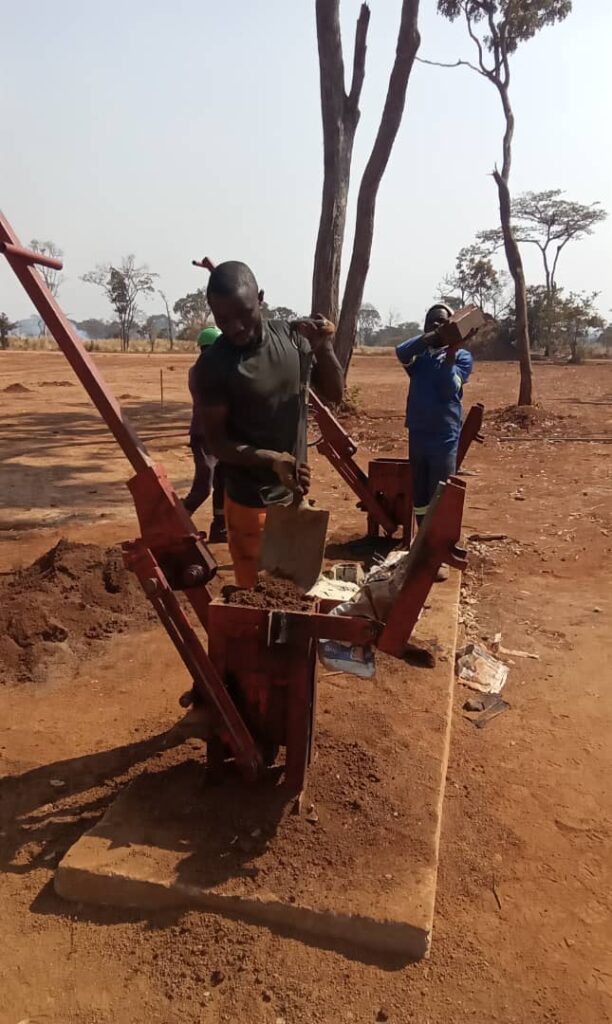
A housing project begins with the people who will use it, the skills they want to develop, and the resources available locally. For supporters considering interlocking blocks in Zambia, a useful first step is to ask how the proposed building system fits those needs.
The Oswell Mwenya Chongo Foundation’s stated focus is community centers in Zambia’s Luapula Province, starting with Chienge, and practical education that supports self-reliance. Improved housing is one part of that vision. This guide offers planning questions for community members, potential partners, and donors; a qualified local project team should make the technical design decisions.
Understand the proposed block system
Interlocking describes the way shaped blocks fit together. One approach uses compressed earth with a stabilizing material, such as cement or lime. The word alone does not mean that a building will be cement-free. UN-Habitat’s 2009 study of interlocking soil blocks in Uganda discusses different blocks, material selection, and the need for suitable skills and maintenance support.
That study provides historical context, not a current price list or performance guarantee for Zambia. Ask the project team to identify the proposed system, explain why it suits the site, and describe how its suitability will be checked.
Put local knowledge and material quality first
Begin the conversation with residents and local builders. What housing problems matter most? Which construction skills already exist? How will people help shape the project and its training opportunities?
Material quality deserves the same attention. Zambia’s National Council for Construction emphasizes testing and site inspections throughout a project’s life, with testing choices shaped by the project and location. Its 2025 Skills Bulletin, pages 6-7 (PDF) explains the role of checks on soil and other construction materials.
For a proposed block project, request a clear plan for assessing locally available materials and checking finished blocks. Ask who will arrange the testing, review the results, and decide whether materials are suitable. These are questions for qualified specialists, rather than judgments to make from a photograph or a machine demonstration.
Plan for skills and upkeep beyond the machine
The same NCC bulletin, pages 8-9 (PDF) connects technical training with teamwork, communication, supervision, and continued learning. This is a useful perspective when reviewing support for practical training.
A planning proposal can explain who will provide training, how learners will practice under supervision, and how their progress will be assessed. It can also identify who will manage the equipment, follow the supplier’s maintenance instructions, obtain spare parts, and arrange repairs. Ask what support will remain available after the initial training ends.
Look at the whole project budget
A machine quotation answers only one part of the funding question. For review, ask the project team to show the proposed budget in understandable groups:
- Preparation: community discussions, site assessment, design work, and the approvals the project requires.
- Equipment and materials: delivery, tools, storage, material sourcing, and testing.
- People: trainers, supervision, labor, and arrangements that allow participants to attend.
- The completed building: foundations, roofing, services, finishing, and other work beyond producing blocks.
- Continued use: maintenance, repairs, record keeping, and an allowance for uncertainties.
This is a discussion checklist, not a cost estimate. Current local quotations and a defined scope are needed before comparing alternatives or suggesting savings.
Questions supporters can ask
- Which decisions have community members helped make, and which remain open?
- What would the proposed contribution fund, and what still needs funding?
- What has been proposed, what has been confirmed, and what has actually been completed?
- Who will check quality and report progress, and what evidence will be shared?
- How will the equipment, training, and building be supported over time?
Clear answers help a supporter understand both the opportunity and the work still ahead. They also make room for contributions of skills, experience, and partnerships alongside financial support.
Start a conversation with OMC
If you would like to discuss practical training, housing ideas, or ways to support the Foundation’s mission, contact The OMC Foundation. Ask about current priorities and the information available for the work you are interested in supporting.
Further reading
- National Council for Construction, Skills Bulletin, issue 4, 2025 (PDF). See pages 6-9 for materials testing and workforce skills.
- UN-Habitat’s Uganda publication, 2009. Historical discussion of interlocking soil-block technology; its case studies do not establish current OMC results or Zambia project costs.